

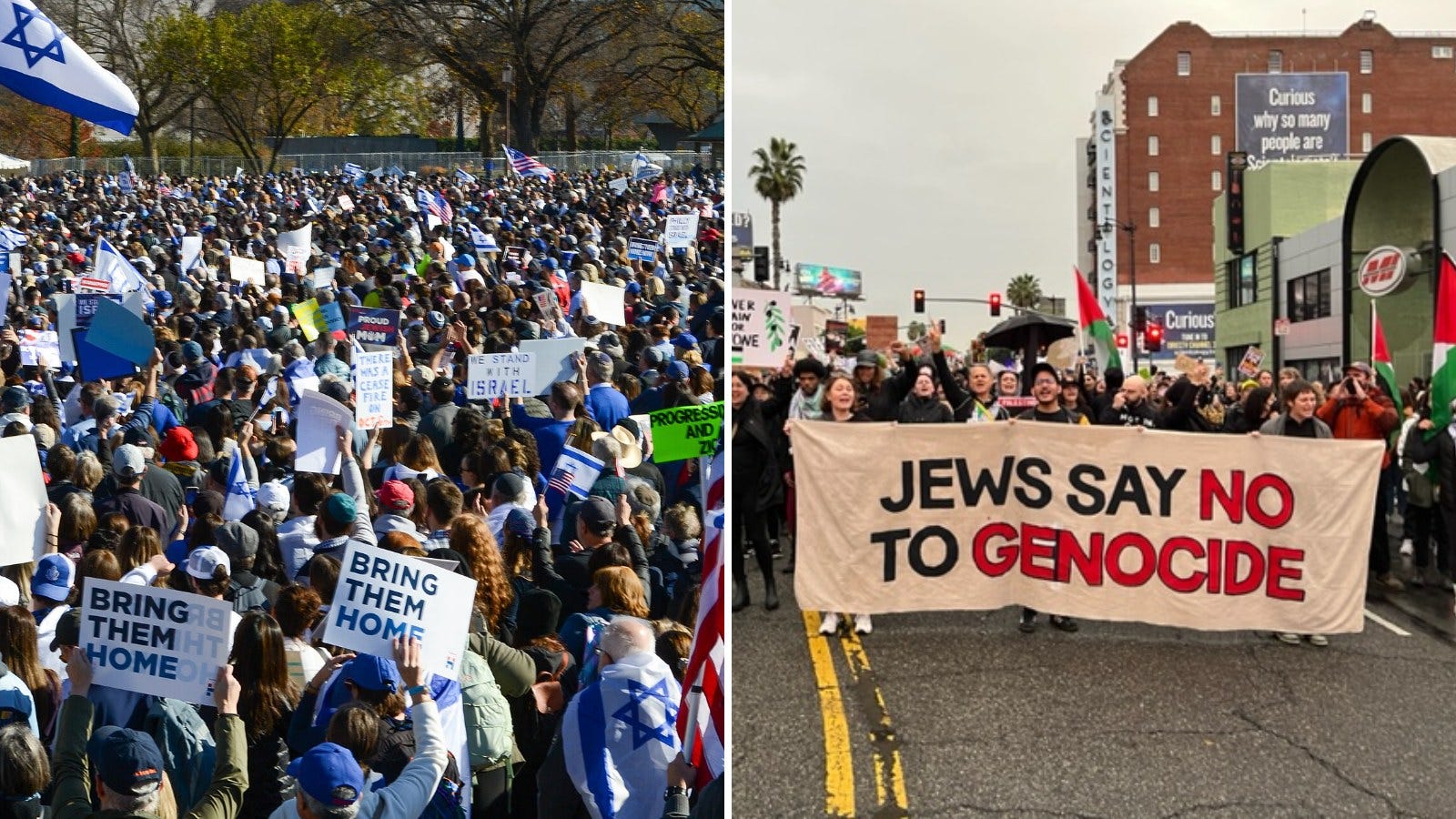


As Michigan heads to the polls in one of the most closely watched Senate races in the country, Abdul El-Sayed’s campaign has once again put Jewish-American identity at the center of American politics. But there’s a lot of haziness surrounding where Jewish-Americans stand vis-a-vis Israel/Palestine and how that’s impacting their politics in the United States. On the one hand, in the wake of October 7th, there was a measurable surge in Jewish-Americans seeking each other out: 43% reported deeper engagement with Jewish life in 2024, and 38% still did in 2026. Emotional attachment to Israel rose too, with between 71% and 79% describing themselves as attached, depending on the survey. On the other hand, 39% of Jewish-Americans believe that Israel’s actions in Gaza constituted a genocide and 61% of Jewish-Americans believe that Israel committed war crimes there. Polling also shows that a mere 37% of Jewish-Americans identify as Zionists. Not to mention the fact that Zohran Mamdani, the most vocal anti-Zionist in American politics, has a higher approval rating among Jewish-Americans (44%) than Benjamin Netanyahu (32%), the Prime Minister of Israel. So how do we make sense of all of this seemingly contradictory data?
A good place to start would be with the work of the Brandeis sociologist Matthew Boxer, who for years has been noticing that the terms Zionism and anti-Zionism are not stable concepts in the Jewish-American lexicon. When he surveyed more than 1,800 North American Jews, he discovered that his respondents were employing wildly different and often incompatible definitions of the terms. As he puts it, borrowing the historian Ilan Troen’s insight that Israel has many narratives, “why wouldn’t there also be multiple narratives of Zionism?” Other surveys substantiate Boxer’s findings. For example, 80% of anti-Zionist Jews say that Zionism means “supporting whatever Israel does,” while only 15% of self-identified Zionists agree with that definition. But beyond the plethora of contradictory casual definitions that people have for these words, 56% of Jewish-Americans don’t self-identify as either Zionist or anti-Zionist. If you spend any time online, this particular statistic should come as a bit of a shock. Social media has a tendency to amplify the loudest and most polarized opinions and that 56% is profoundly under-represented in the online discourse.
Having said all of that, the events of the last three years in Israel/Palestine have had a polarizing effect on Jewish-Americans. For many, October 7th was a slap in the face and a wake-up call. For these people, October 7th, the deadliest day for Jews since the Holocaust, could only be understood as pure antisemitism, stripped of any context, including Israel’s decades-long occupation and the conditions in Gaza. This narrative was further propped up by atrocity stories that turned out to be false, including the “40 beheaded babies,” a baby burned in an oven, and a fetus cut from a pregnant woman, all later debunked by Israeli journalists. Those stories fed a permission structure for whatever Israel would do in Gaza. For this group of people, Hamas were worse than the Nazis and therefore the extraordinary measures that Israel employed in fighting them were ipso facto justified. Moreover, anyone who criticized Israel’s actions was obviously siding with evil. Through accident of birth, I am connected to a lot of people who think like this and I can tell you that this narrative and the permission structure that it propped up led these people to loudly justify the worst atrocities that the State of Israel has ever committed. I remember watching in horror as my social media feeds filled with justification, denialism, and dehumanization. I saw it online. I saw it in synagogue. There was no escaping it. There is to this day a lot of energy with this group of Jewish-Americans who I’ve come to call the “Am Yisrael Chai crowd” (the people of Israel lives) after a chant that they often sing when they congregate. These people are still in charge of our institutions and therefore wield disproportionate power over our public discourse and institutional politics.
The last three years have also pushed a sizable group of Jewish-Americans to completely reconsider their relationship with the State of Israel and indeed with Zionism. Jewish Voice for Peace, an explicitly anti-Zionist organization, has swelled with record numbers of new recruits, gaining more than 20,000 members in a single year, who were prominently featured at the campus protests for Gaza. Books are now being published at a rapid clip from people like Molly Crabapple and Benjamin Moser and Shaul Magid reclaiming the history of specifically Jewish forms of anti-Zionism.
Some in this crowd are also part of the anti-imperialist left who see the attacks of October 7th as a legitimate form of resistance to the Israeli occupation and I watched in horror as they formed a mirror image to the Am Yisrael Chai crowd and minimized the atrocities committed by Hamas on that day. Many of these folks also seem to have a tin ear to some of the antisemitism that does exist in some of the darker corners of the Palestine solidarity world, and some have even shared platforms with problematic media figures like Candace Owens for her criticisms of Israel.
The anti-Zionist Jews are on average much younger than the Am Yisrael Chai folks and therefore have only known Benjamin Netanyahu’s Israel. They have no living memory (and generally little knowledge) of Israel during the Oslo years. Which is not to suggest that a familiarity with it would necessarily change their thinking about Israel. On the ideological Left, the State of Israel is seen as rotten to the core and the dramatic political shift to the right that occurred in Israel over the last few decades is often dismissed as a mere slip of the mask.
So where does all of this leave us in terms of what’s coming next politically? We’ve already gotten glimpses of it. Zohran Mamdani was elected mayor of New York City with 33% of the Jewish vote, even as the Am Yisrael Chai crowd rallied behind a Cuomo campaign that trafficked in Islamophobia, from a racist AI-generated attack ad to Cuomo laughing along when a radio host suggested Mamdani would cheer another 9/11. The same thing is happening in Michigan, where AIPAC’s super PAC spent a record $30.6 million trying to defeat Abdul El-Sayed in the primary, as he faced a wave of attacks painting him as a terrorist sympathizer, and where Trump has since called him a “vicious, violent jihadist.” The days when Jews could be relied upon to vote near-unanimously on Israel are over. We’re living in an age where public association with AIPAC is a political liability. And with the energy in the Democratic Party being squarely on the progressive Left, the issue of Gaza has become a litmus test for those running for office. These trends are as clear as they are inevitable. The Am Yisrael Chai crowd is losing, and while they still hold much of the power, they’re losing Jewish-Americans: a third of Jews aged 18 to 34 now call themselves anti-Zionist or non-Zionist.
We in the Jewish community have been tearing each other to shreds over the last few years and it doesn’t have to be this way. The truth of the matter is that many of us don’t have fully formed views on Zionism or Israel and those of us who do need to take the temperature down. I understand that these issues touch on our identity and our core values. But one of those values that we should all share is tolerance. The world produced two political answers to the horrors of European antisemitism. One was a Jewish-majority state in Palestine. The other was a multicultural civic democracy in the United States. The half of us Jews who are privileged enough to live in the United States of America owe it to each other and to our ancestors to be better stewards of the historic gifts we enjoy.
Eli, I appreciate this piece and your pointing out that labels like “Zionist” and “anti-Zionist” might mean very different things to different people. But shouldn’t the same caution extend to labels like the “Am Yisrael Chai” crowd. That phrase expresses something meaningful to many Jews who may hold vastly different views about Israel, its government, and the war in Gaza. Not everyone (i.e. me) is so clued into the nuance of what a particular expression/word carries in its most popular context. When we attach a particular political outlook to a familiar expression of Jewish identity and solidarity, don’t we risk doing what your piece warns against?